The Rolex Oyster Perpetual 100 Years Has a Problem
Rolex could have celebrated 100 years of the Oyster with something spectacular.
A platinum case would have been easy to justify. So would a gem-set dial, an elaborate caseback, or a high-priced commemorative model aimed squarely at established collectors.
Instead, Rolex chose the Oyster Perpetual.
That decision is more interesting than the small “100 years” inscription on the dial.
The 2026 Oyster Perpetual “100 Years” is fundamentally a simple automatic Rolex with three hands, an Oyster bracelet, 100 metres of water resistance, and no date or complication. Its anniversary treatment is restrained: a yellow-gold bezel and crown, a slate sunray dial, green details, a tiny commemorative inscription at 6 o’clock, and the number 100 on the winding crown.
It looks like a watch designed to be worn frequently.
The collector market may have other ideas.
That creates the contradiction at the center of this anniversary Rolex. If the Oyster Perpetual 100 Years becomes difficult to obtain and develops a substantial secondary-market premium, owners may become increasingly reluctant to use it in the uncomplicated way its design encourages.
For a watch celebrating one of Rolex’s most important practical inventions, that would be a strange outcome.
First, It Is the Oyster That Is 100 Years Old
The name of the watch creates an easy historical misunderstanding.
The Oyster Perpetual did not appear in 1926.
The Oyster did.
Hans Wilsdorf introduced the Rolex Oyster in 1926 as a completely waterproof and dustproof wristwatch. At a time when wristwatches remained vulnerable to moisture and contamination, protecting the movement inside a sealed case was not merely a design exercise. Reliability was central to the argument for wearing a watch on the wrist rather than carrying a protected pocket watch.
Rolex followed that achievement with another major development in 1931: the Perpetual rotor, its self-winding system.
The modern Oyster Perpetual combines those ideas with an earlier Rolex achievement in chronometric precision. Rolex therefore describes the model as bringing together three foundations of the company: precision, waterproofness, and automatic winding.
The 2026 anniversary celebrates the first of those milestones.
That distinction matters because the watch is not simply marking the birthday of a product line. It is commemorating the case architecture that eventually became the foundation for much of modern Rolex.
Rolex Chose Its Simplest Watch for a Complicated Anniversary
Look at the wider Oyster family and the decision becomes more deliberate.
The Oyster architecture eventually supported the Datejust, Explorer, Submariner, GMT-Master, Daytona, Sea-Dweller, Yacht-Master, and other watches that developed much stronger individual identities.
Rolex could therefore have attached the centenary to a more prestigious or technically elaborate model.
The Oyster Perpetual makes more historical sense.
Strip away the rotating bezels, chronographs, date displays, dual time zones, and professional associations that accumulated over the following century, and the essential Rolex proposition remains surprisingly simple: a precise automatic wristwatch protected from everyday life by a robust case.
The OP is the closest modern expression of that idea.
That makes the anniversary model less spectacular than it might have been, but arguably more coherent.
The Anniversary Details Are Almost Comically Small
Rolex did not redesign the Oyster Perpetual to make the anniversary obvious.
The slate dial carries the Rolex name and small minute-track squares in green. At 6 o’clock, “100 years” replaces the normal “Swiss Made” inscription. The yellow-gold winding crown carries a small 100 beneath the Rolex coronet.
There is no transparent caseback.
There is no large anniversary engraving.
There is no elaborate commemorative emblem occupying the dial.
From several feet away, most people would probably identify it simply as a two-tone Oyster Perpetual.
That restraint is significant because Rolex has historically been comfortable letting enthusiasts infer anniversary associations without printing them explicitly on the watch. The company has used green and unusual configurations to mark milestones before, while leaving the connection to collectors to understand.
For the Oyster centenary, Rolex finally wrote the occasion on the watch.
It just wrote it very quietly.
The Two-Tone Configuration Is More Interesting Than It First Appears
Calling the watch “two-tone” can create the wrong mental image.
This is not a Datejust with gold running through the center links of the bracelet. The Oyster bracelet remains Oystersteel. Yellow gold is concentrated on the domed bezel and winding crown, while gold-colored dial furniture brings warmth into the slate surface.
The result changes the visual balance of the watch without turning it into a conventional full-Rolesor design.
That matters because the Oyster Perpetual has historically depended on simplicity. Adding too much gold could have pushed the model toward Datejust territory, where combinations of precious metal, fluted bezels, Jubilee bracelets, and date displays already provide a more decorative Rolex experience.
Instead, the gold works almost like punctuation.
It is noticeable without becoming the entire sentence.
Whether someone likes that choice is another matter. Two-tone remains one of the most divisive Rolex aesthetics, and buyers who fundamentally dislike yellow gold are unlikely to be converted simply because the watch commemorates an anniversary.
Rarity does not fix personal taste.
The Slate Dial Does Much of the Work
The dial may be more important to the watch’s long-term appeal than the anniversary text.
Slate creates a neutral foundation between the warm yellow gold and Rolex green. In direct light, the sunray finish gives the dial considerably more variation than a flat grey surface would suggest, while under softer conditions the same watch becomes much more restrained.
This difference between photography and actual viewing is beginning to appear in owner discussion.
One recent buyer who encountered both the 36mm and 41mm versions in Munich described the watch as substantially more impressive in person and ultimately chose the 36mm. Other reactions to the release have similarly focused on how the green, grey, steel, and gold combination changes with lighting rather than presenting one fixed appearance.
Those reports remain individual experiences rather than objective proof that the watch “looks better in person,” but they highlight a useful limitation of judging the OP100 from press images.
Sunray dials are responsive surfaces.
A studio photograph freezes one lighting condition.
A wrist does not.
36mm and 41mm Are Not Merely Two Versions of the Same Decision
Rolex offers the anniversary watch in 31mm, 36mm, and 41mm.
For many male buyers, the practical argument will center on 36 versus 41.
Online discussion tends to turn this into a vote. One group treats 36mm as the historically correct Rolex proportion, while another prefers the greater presence of the 41mm case.
That framing is not particularly useful.
The better question is what role the watch will play.
The Oyster Perpetual has no external bezel, crown guards, chronograph pushers, or date magnifier to add visual complexity. A large portion of its appearance comes from the relationship between dial, bezel, case, and bracelet. Increasing the diameter therefore changes more than the number on the specification sheet; it changes how much visual space the dial occupies on the wrist.
A 36mm OP can disappear under a cuff and behave like a restrained everyday watch. The 41mm makes the same basic design more assertive.
Neither is automatically correct.
The important point is that someone accustomed to 40mm sports watches should not assume 36mm will feel inadequate, just as someone who likes traditional Rolex proportions should not choose 36mm solely because enthusiasts describe it as the “correct” size.
Try both.
The watch is simple enough that proportion becomes one of its main features.
Owner Discussions Show Why Wrist Photos Are Unreliable
Recent size discussions around the Oyster Perpetual repeatedly produce conflicting answers even when photographs are provided.
Some owners see the 36mm as more elegant and versatile. Others find the 41mm more natural on the same approximate wrist size. One buyer who initially assumed 41mm would be too large reported that it looked much less bulky in person than it did through a phone camera.
That observation is useful.
Close smartphone photographs can exaggerate watch size because the camera is positioned near the wrist, while lens choice and angle distort the relationship between case and arm. A mirror photograph taken from farther away often produces a more realistic impression of how a watch looks to other people.
The practical lesson is not that 36mm is better.
It is that Reddit cannot size your watch for you.
Use community photographs to understand possibilities, then make the final decision on your own wrist.
The 36mm Version Has a Strong Historical Argument Without Needing Nostalgia
There is still a reason the 36mm anniversary model feels especially coherent.
For much of Rolex history, dimensions around this range were entirely normal for men’s watches. The idea that a luxury watch needs a 40mm-plus case to have sufficient presence is comparatively recent.
The current shift toward smaller watches has made those older proportions easier for contemporary buyers to reconsider, but the OP36 does not need a fashion cycle to justify itself.
Its appeal comes from the architecture.
A simple three-hand watch benefits from compactness because there is relatively little information that requires dial space. The smaller case allows the bracelet and bezel to contribute more strongly to the overall composition instead of letting the dial dominate the wrist.
This is also why someone can happily wear a 40mm Submariner and prefer a 36mm Oyster Perpetual.
Diameter does not need to remain consistent across a collection.
Purpose and design matter.
Calibre 3230 Is Almost Too Easy to Ignore
The anniversary treatment naturally attracts attention, but underneath it Rolex uses the familiar calibre 3230.
That means approximately 70 hours of power reserve, automatic winding through the Perpetual rotor, and the modern Rolex movement architecture used in several no-date references.
There is no anniversary complication.
That is appropriate.
The original Oyster’s importance was not that it displayed more information. Its significance came from making the wristwatch more dependable as an object.
The OP100 follows the same philosophy. The movement is not there to provide mechanical theatre through a display back. It is there to wind automatically, keep time, and remain protected inside the Oyster case.
A century after waterproofness was revolutionary, reliability has become so normal that it is easy to overlook.
That may be the Oyster’s greatest success.
The Most Important Rolex Innovations Eventually Become Boring
This is where the centenary becomes more interesting than the commemorative watch itself.
Water resistance is expected today.
Automatic winding is expected.
A screw-down crown is familiar.
A sealed sapphire-crystal watch that can survive swimming without special preparation does not sound radical.
In 1926, the problem looked very different.
Dust, humidity, and water could reach a wristwatch movement much more easily, threatening accuracy and reliability. The Oyster case helped turn environmental protection into something a wristwatch owner could take for granted.
Rolex then became exceptionally good at demonstrating the idea. Mercedes Gleitze’s 1927 English Channel swim became part of the company’s early public proof of waterproofness, while later Rolex advertising and sporting associations repeatedly connected watches with real environments rather than treating them solely as jewellery.
The technology succeeded so thoroughly that its original problem has largely disappeared from the modern buyer’s mind.
We notice the dial color.
We debate 36mm versus 41mm.
We discuss allocation.
We speculate about resale value.
Few buyers stand at an authorized dealer wondering whether dust will destroy the movement.
That is what 100 years of progress looks like.
The Anniversary Creates an Allocation Problem
Rolex describes the OP100 as a special edition, but the more practical question for buyers is availability.
The watch may have an official retail price, yet that does not mean every interested customer can buy one immediately.
Recent owner reports already show very different experiences.
One buyer reported seeing both 36mm and 41mm exhibition examples before receiving a 36mm allocation surprisingly quickly after expressing interest. Another Oyster Perpetual buyer described waiting far longer for a regular OP36, while others report being warned that anniversary availability could be difficult.
These anecdotes are useful precisely because they conflict.
They tell us that there is no reliable universal waiting period.
Allocation depends on dealer inventory, location, configuration, customer history, timing, and factors outsiders cannot observe.
Anyone claiming that the OP100 is either “easy to get” or “impossible to get” based on one boutique experience is generalizing too far.
Scarcity Is Not the Same Thing as Collectibility
The anniversary wording almost guarantees speculation.
There is a dateable event.
There are unusual design details.
The configuration is distinct from a standard steel Oyster Perpetual.
And buyers do not know exactly how long Rolex will produce it or how many examples will ultimately reach the market.
Those ingredients can produce scarcity.
They do not guarantee long-term collectibility.
Collectors eventually care about more than initial difficulty.
Design matters.
Historical relevance matters.
Condition matters.
Production duration matters.
How the watch fits into Rolex history matters.
Most importantly, future collectors have to continue wanting it after the launch excitement disappears.
A difficult allocation in 2026 tells us something about supply and demand in 2026.
It does not tell us what collectors will think in 2046.
The “Rare Rolex” Problem Can Make a Good Watch Worse to Own
The Time+Tide owner’s experience exposes a contradiction that deserves more attention than the secondary-market speculation.
The Oyster Perpetual is arguably one of the easiest Rolex watches to use as a daily companion. It has no complicated functions to set, no precious-metal bracelet to baby, no rotating bezel, and no elaborate finishing that demands ceremonial treatment.
Yet the owner admitted that the perceived specialness of the anniversary model was already making him more selective about when he wore it.
That is understandable.
It is also slightly unfortunate.
The more a buyer thinks of the OP100 as a future collectible, the more scratches become financial events. A bracelet mark is no longer simply evidence that the watch was worn. It becomes possible lost resale value.
The watch starts spending more time in a box.
At some point, the collector can become the custodian of an asset rather than the owner of a wristwatch.
Buying It for the Anniversary and Buying It for Yourself Are Different Decisions
The OP100 gives buyers several legitimate reasons to want it.
Someone may care deeply about Rolex history.
Someone may have a personal milestone in 2026.
Another buyer may simply love slate, green, and yellow gold.
A collector may want an unusual Oyster Perpetual configuration.
Someone else may see the anniversary inscription and immediately start thinking about future value.
Only the last motivation requires special caution.
A watch can be historically significant without becoming a great financial asset.
It can become collectible without being especially liquid.
It can command a secondary-market premium and later lose it.
It can also become extremely valuable while spending decades being a watch you never particularly enjoyed wearing.
The strongest reason to buy the OP100 is therefore the least exciting one: you would still want the watch if nobody expected it to appreciate.
The Gold Bezel Will Eventually Tell the Truth
There is another practical issue that rarely appears in launch coverage.
Gold is softer than steel.
The polished yellow-gold bezel and crown that distinguish the OP100 will accumulate wear differently from the Oystersteel case and bracelet. Fine scratches and small marks are inevitable if the watch becomes a genuine daily wearer.
For some owners, that will improve it.
The anniversary Rolex will gradually stop looking like the example photographed at Watches and Wonders and start looking like their watch.
For collectors trying to preserve maximum condition, the same process will be unwelcome.
That creates an ownership choice from the beginning.
Wear it normally and accept that the most visually distinctive metal on the watch will record use, or preserve it carefully because future collectors may care about condition.
There is no technical solution to that conflict.
It is a collecting decision.
The Oyster Bracelet May Be the Most Important Everyday Feature
The anniversary markings will dominate discussion, but they do little for daily comfort.
The bracelet does.
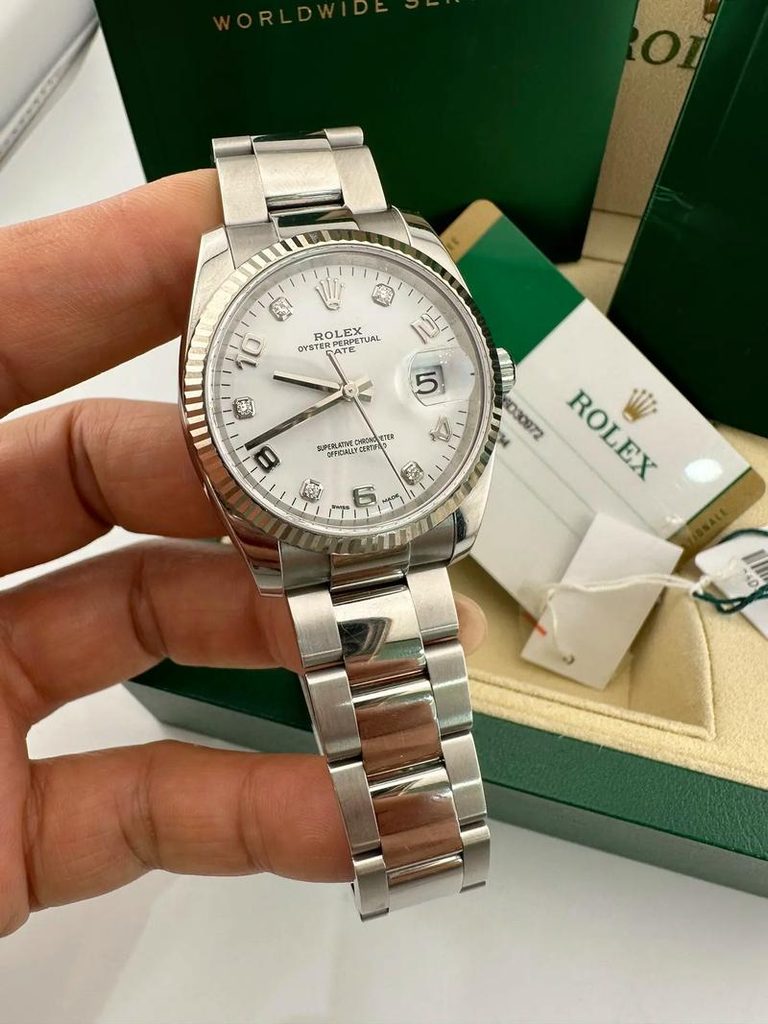
The OP uses the three-piece Oyster bracelet, keeping the overall watch visually simpler than a Jubilee-equipped Datejust. On the anniversary model, leaving the bracelet in steel also prevents the yellow gold from becoming too dominant.
More importantly, the bracelet helps explain why an Oyster Perpetual can work as an everyday watch despite its luxury positioning.
The case and bracelet form a relatively uncomplicated package without the visual weight of a professional bezel or the dressier texture of a Jubilee bracelet.
This is one of those details that rarely produces an exciting headline but affects every hour the watch spends on the wrist.
A commemorative inscription may influence why someone buys the watch.
Bracelet comfort influences whether they keep wearing it.
It Is Worth Asking What You Would Buy Without the Words “100 Years”
There is a simple test for anyone considering the watch.
Imagine the same slate dial, green accents, steel Oyster bracelet, yellow-gold bezel, and yellow-gold crown, but remove the “100 years” text and the 100 on the crown.
Would you still want it?
If the answer is yes, the anniversary becomes a meaningful bonus.
If the answer is no, it is worth understanding what exactly is driving the purchase.
Perhaps historical significance genuinely matters to you. There is nothing wrong with that. Collecting is full of objects whose meaning comes from context rather than pure design.
But if the answer is simply that the watch might be rare, the decision has shifted from watch collecting toward speculation.
That deserves a different level of caution.
The OP100 Makes More Sense When You Stop Treating It as a Trophy
The Oyster Perpetual 100 Years is not Rolex’s most technically complicated watch of 2026, nor is it the most visually dramatic.
That may be exactly why it works.
The original Oyster mattered because it helped make the wristwatch more practical. The Perpetual rotor later made automatic winding part of that same pursuit of convenience. Over time, those technologies became so deeply integrated into Rolex that contemporary owners barely think about them.
A simple three-hand Oyster Perpetual is therefore an unusually appropriate place to commemorate the anniversary.
The irony is that modern Rolex collecting can push the watch in the opposite direction.
Scarcity encourages preservation.
Premiums encourage caution.
Anniversary status encourages owners to think about future collectors.
A watch built around the idea of dependable everyday use can slowly become something people are afraid to scratch.
There is no need to resolve that contradiction for every owner. Some buyers will preserve the OP100 carefully, others will wear it constantly, and both choices can make sense.
But anyone considering the watch should decide which kind of owner they want to be before worrying about what the secondary market thinks.
A hundred years ago, the Oyster helped make the wristwatch easier to live with.
Read More »